What Is Blockchain Technology? Simple Explanation for Beginners
 admin
13 min read
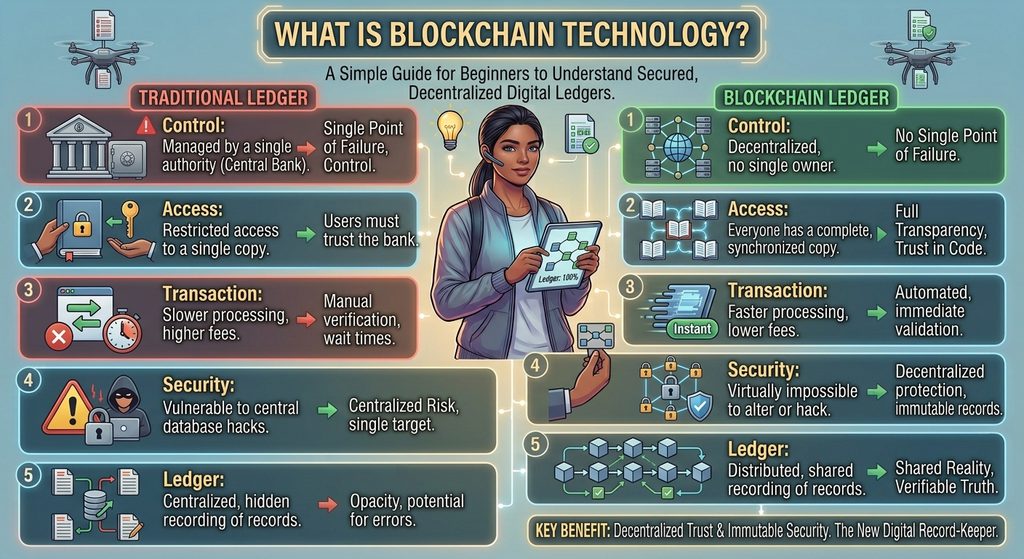
If you’ve heard about Bitcoin, Ethereum, NFTs, smart contracts, or cryptocurrency, you’ve probably come across the term blockchain.
But what exactly is blockchain technology?
In simple terms, a blockchain is a digital record-keeping system that stores information across a network of computers. Instead of relying on one central database controlled by a single organization, many blockchain networks distribute copies of their records among participating computers.
This structure can make blockchain records difficult to alter after they have been confirmed and added to the network.
Blockchain technology is most famous for powering cryptocurrencies such as Bitcoin, but its potential applications extend beyond digital currencies.
Let’s break down how it works in simple language.
What Is a Blockchain?
The word blockchain can be understood by breaking it into two parts:
Block + Chain
A block is a collection of information or transactions.
A chain is the sequence connecting those blocks together.
When transactions are grouped into a block and that block is added to previous blocks, the result is a chronological chain of records.
For example:
Block 1 → Block 2 → Block 3 → Block 4 → Block 5
Each new block becomes part of the existing record.
This is one of the fundamental ideas behind blockchain technology.
A Simple Example of Blockchain
Imagine five friends keep a shared notebook.
Every time one person pays another person, everyone writes the transaction into their own copy of the notebook.
If Alex pays Sarah $20, the group records:
Alex → Sarah: $20
Everyone has a copy of the record.
If Alex later tries to claim:
“I never paid Sarah.”
The other copies can be checked.
A blockchain works on a much more sophisticated technical level, but this example illustrates the basic idea of shared record keeping.
Instead of one person controlling the record, multiple participants help maintain and verify it.
Why Was Blockchain Created?
One of the biggest challenges with digital money is the possibility of double spending.
Imagine you have a digital file representing $10.
Because digital information can be copied, how can the system make sure you don’t spend that same $10 twice?
Traditional financial systems solve this problem using centralized institutions such as banks and payment processors.
Blockchain networks introduced another approach.
Instead of relying entirely on one central authority, blockchain networks can use a combination of:
- Cryptography
- Distributed networks
- Consensus mechanisms
- Transaction verification
- Public or permissioned records
These mechanisms help participants agree on the state of the blockchain.
Bitcoin was one of the first major systems to demonstrate how a decentralized network could maintain a digital transaction record without relying on a traditional central financial institution.
How Does Blockchain Work?
Although blockchain systems can become technically complex, the basic process can be explained in several steps.
Step 1: Someone Initiates a Transaction
Suppose Alice wants to send cryptocurrency to Bob.
She creates a transaction using her cryptocurrency wallet.
The transaction contains information such as:
- The sender’s address
- The recipient’s address
- The amount
- Other data required by the blockchain
The transaction is then broadcast to the network.
Step 2: The Network Receives the Transaction
Computers participating in the blockchain network receive the transaction.
These computers may be called nodes.
Nodes can check whether the transaction follows the network’s rules.
For example, the network needs to determine whether the transaction is properly authorized and whether the sender has sufficient funds under that blockchain’s rules.
Step 3: Transactions Are Grouped Into a Block
Valid transactions can be collected into a block.
A block may contain many transactions rather than just one.
The exact process varies depending on the blockchain.
Step 4: The Network Reaches Consensus
Blockchain networks need a way for participating computers to agree on which transactions should be accepted and what the next valid block should be.
This is called a consensus mechanism.
Different blockchains use different approaches.
Two well-known examples are:
Proof of Work
Bitcoin uses Proof of Work.
Participants known as miners compete to solve computationally difficult problems as part of the process of adding new blocks to the blockchain.
Proof of Stake
Many newer blockchain networks use Proof of Stake or related mechanisms.
Instead of relying primarily on computational work, these systems use participants who commit or “stake” cryptocurrency according to the network’s rules.
These mechanisms have different technical designs, advantages, limitations, and security considerations.
Step 5: The Block Is Added to the Blockchain
After the network accepts a block according to its consensus rules, it becomes part of the blockchain.
The new block references information from previous blocks.
This creates the chain:
Previous Block → New Block → Next Block
As additional blocks are added, changing an old transaction becomes increasingly difficult on many blockchain networks.
Why Is Blockchain Considered Secure?
Blockchain security comes from several technologies and mechanisms working together.
Cryptography
Blockchain systems use cryptographic techniques to protect transactions and establish authenticity.
Decentralization
Many blockchain networks distribute copies of the ledger across numerous computers.
There isn’t necessarily one central database that can simply be edited by one person.
Consensus
Participants need to follow the network’s consensus rules when determining which transactions and blocks are accepted.
Linked Blocks
Blocks are connected using cryptographic information.
Changing historical information can therefore require overcoming additional technical and network-level protections.
However, blockchain does not mean automatically secure or completely unhackable.
Wallets, exchanges, smart contracts, applications, and users can still be vulnerable to attacks, scams, software bugs, and other risks.
What Is Decentralization?
Decentralization is one of the most important concepts associated with blockchain.
In a traditional centralized database, one organization may control the system.
For example:
Users → Bank → Central Database
The bank manages the records and determines how the database operates.
A decentralized blockchain network can look more like:
User ↔ Network of Computers ↔ Blockchain
Different participants can maintain copies of the ledger and follow common rules.
However, decentralization exists on a spectrum.
Not every blockchain is equally decentralized, and some blockchain-based systems have significant levels of control concentrated among particular organizations or groups.
What Is a Blockchain Node?
A node is a computer or other system participating in a blockchain network.
Depending on the blockchain and the type of node, it may:
- Store blockchain data
- Verify transactions
- Relay transactions
- Validate blocks
- Participate in consensus
Nodes help keep the network operating according to its rules.
The exact responsibilities of a node depend on the particular blockchain.
What Is a Block?
A block is essentially a package of information added to the blockchain.
Depending on the network, a block can contain:
- Transactions
- A timestamp or related block information
- A reference to a previous block
- A cryptographic hash
- Consensus-related information
- Other blockchain-specific data
Think of each block as a page in a continuously growing digital record book.
What Is a Hash?
A hash is the output produced when data is processed through a cryptographic hash function.
You can think of it as a digital fingerprint for a particular piece of information.
If the underlying data changes, the resulting hash generally changes as well.
Blockchain systems use cryptographic hashes in several ways, including connecting blocks and helping verify data.
For example:
Data → Hash Function → Digital Fingerprint
This doesn’t mean hashes make every blockchain completely immutable, but they are an important part of the technology’s security design.
What Is Immutability?
You’ve probably heard people say:
“Blockchain records are immutable.”
This means that once information has been sufficiently confirmed on a blockchain, changing historical records can be extremely difficult under the network’s normal operating rules.
However, “immutable” doesn’t mean absolutely impossible to change under every conceivable circumstance.
Different blockchain networks have different security models, governance systems, and levels of decentralization.
A blockchain’s resistance to modification depends on its technical design and the assumptions behind its consensus mechanism.
Blockchain vs Traditional Database
Here’s a simple comparison:
| Feature | Traditional Database | Blockchain |
|---|---|---|
| Control | Often centralized | Often distributed |
| Record management | Controlled by an organization | Maintained according to network rules |
| Data changes | Authorized administrators can modify records | Changes follow blockchain rules |
| Transparency | Depends on the system | Often publicly verifiable on public blockchains |
| Speed | Can be extremely fast | Depends on blockchain design |
| Central authority | Usually present | May be reduced or absent |
| Cryptography | May be used | Fundamental to many blockchain systems |
Blockchain isn’t necessarily better than a traditional database for every application.
Sometimes a conventional database is faster, cheaper, and simpler.
The value of blockchain depends on the problem you’re trying to solve.
What Is Bitcoin’s Relationship With Blockchain?
Bitcoin is a cryptocurrency that uses blockchain technology.
The Bitcoin blockchain records Bitcoin transactions.
A simplified relationship is:
Blockchain = Technology
Bitcoin = Cryptocurrency using that technology
Blockchain technology can therefore exist independently of Bitcoin.
Bitcoin was a major breakthrough in demonstrating a decentralized digital currency system based on blockchain and cryptographic principles.
What Is Ethereum?
Ethereum is another major blockchain network.
Unlike Bitcoin, which was initially designed primarily around decentralized digital money, Ethereum was designed as a more general-purpose blockchain capable of running programmable applications known as smart contracts.
Ethereum supports its own cryptocurrency, Ether (ETH).
This allows developers to build various applications on top of the Ethereum network.
What Are Smart Contracts?
A smart contract is a program deployed on a blockchain that executes according to predefined rules.
Despite the name, a smart contract isn’t necessarily a traditional legal contract.
For example, a smart contract could be programmed so that:
If condition A occurs → perform action B
Smart contracts are important because they allow blockchain networks to support applications beyond simple cryptocurrency transfers.
They are used in areas such as:
- Decentralized finance
- Token systems
- Digital collectibles
- Decentralized applications
- Automated transactions
However, smart contracts can contain bugs, and interacting with them can involve financial and technical risks.
What Are the Uses of Blockchain?
Blockchain technology is used or explored for many different applications.
1. Cryptocurrency
Cryptocurrency remains the most famous blockchain application.
Bitcoin, Ethereum, and many other digital assets use blockchain networks.
2. Payments
Blockchain networks can facilitate digital transfers without using traditional payment infrastructure in every situation.
3. Decentralized Finance
Blockchain technology enables financial applications that can operate through smart contracts.
4. Digital Assets
Blockchain networks can represent ownership or control of digital tokens.
5. Supply Chain Tracking
Organizations can explore blockchain for tracking products and records across supply chains.
6. Digital Identity
Blockchain-based systems have been explored for identity-related applications.
7. Record Keeping
Blockchain can provide a shared record that multiple parties can independently verify.
However, whether blockchain is appropriate for a particular use case depends on cost, scalability, privacy, governance, and other requirements.
What Are the Advantages of Blockchain?
Blockchain technology can provide several potential advantages.
Transparency
Public blockchain transactions can often be viewed and independently verified.
Distributed Record Keeping
Information can be maintained across multiple participating systems rather than a single database.
Reduced Dependence on Intermediaries
Some blockchain applications can reduce the need for certain intermediaries.
Cryptographic Security
Cryptographic techniques help authenticate and protect blockchain transactions.
Programmability
Smart-contract platforms can allow developers to create programmable applications.
What Are the Disadvantages of Blockchain?
Blockchain also has limitations.
Scalability
Some blockchain networks can face limitations in transaction throughput or congestion.
Transaction Fees
Network fees can increase when demand is high.
Complexity
Blockchain technology can be difficult for beginners to understand and use safely.
Irreversible Transactions
Many blockchain transactions cannot simply be reversed after confirmation.
Security Risks
Blockchain networks may be robust while applications, wallets, exchanges, and smart contracts built around them remain vulnerable.
Energy Consumption
Some consensus mechanisms, particularly Proof of Work, can consume substantial amounts of energy.
Regulatory Uncertainty
Rules surrounding cryptocurrencies and blockchain applications differ between countries and can change over time.
Is Blockchain the Same as Cryptocurrency?
No.
This is one of the most common beginner misunderstandings.
Blockchain is the underlying technology.
Cryptocurrency is one type of application built using blockchain technology.
An easy analogy is:
Internet → Technology
Email → Application using the technology
Similarly:
Blockchain → Technology
Bitcoin → Application/use of that technology
The analogy isn’t perfect, but it helps explain the relationship.
Is Blockchain Anonymous?
Not necessarily.
Many public blockchains are better described as pseudonymous rather than completely anonymous.
A blockchain address may not directly display your real-world name.
However, transactions associated with an address can often be publicly visible.
If an address becomes linked to a person’s real identity through an exchange, investigation, or other information, historical transactions associated with that address may potentially be analyzed.
Privacy therefore depends heavily on the specific blockchain and the tools being used.
Can Blockchain Be Hacked?
The answer depends on what you mean by “hacked.”
Attacking the underlying blockchain consensus can be extremely difficult on large, well-established networks, but blockchain systems are not magically immune to attacks.
Other components can be compromised, including:
- Cryptocurrency exchanges
- Wallets
- Smart contracts
- Bridges
- DeFi applications
- User accounts
- Private keys
This is why blockchain security involves more than simply asking whether the blockchain itself is secure.
Users must also protect their wallets and credentials.
Blockchain Explained in One Simple Example
Imagine a school where every student receives a copy of the same attendance record.
Every day, a new page is added.
Before a new page becomes official, the system checks that the information follows the school’s rules.
Once accepted, the page references the previous page.
Everyone keeps their own copy.
If someone secretly changes an old page, the other copies can reveal the discrepancy.
A real blockchain uses sophisticated cryptography, networking protocols, and consensus mechanisms rather than students and paper.
But the example captures the basic concepts:
Shared records + verification + cryptography + linked data + consensus
Frequently Asked Questions
Is blockchain only used for Bitcoin?
No. Bitcoin is one important application of blockchain technology. Other blockchain networks support cryptocurrencies, smart contracts, decentralized applications, and other digital assets.
Can blockchain transactions be reversed?
Many blockchain transactions are designed to be difficult or impossible to reverse after confirmation. This varies by network and application.
Is blockchain safe?
Blockchain technology can provide strong security properties, but no technology is completely risk-free. Wallets, exchanges, smart contracts, and users can still be vulnerable.
Do I need cryptocurrency to use blockchain?
Not necessarily. Some blockchain applications may be used without directly owning cryptocurrency, although many public blockchain applications involve digital assets or transaction fees.
Is blockchain the same as Bitcoin?
No. Bitcoin is a cryptocurrency. Blockchain is the technology used by Bitcoin to maintain its transaction history.
Who controls a blockchain?
It depends on the blockchain. Some are designed to be highly decentralized, while others have more concentrated control.
Final Thoughts
Blockchain technology can sound complicated because it combines several different concepts: cryptography, computer networking, distributed databases, consensus mechanisms, and digital assets.
But the basic idea is relatively simple.
A blockchain is a system for maintaining a shared digital record in which transactions or other information are organized into blocks and linked together according to the rules of the network.
Bitcoin demonstrated one powerful application of this technology: decentralized digital money.
Other blockchain networks have expanded the concept to smart contracts, decentralized applications, digital assets, and other use cases.
The technology has potential, but it also has limitations and risks. Understanding those trade-offs is essential before using cryptocurrency or blockchain-based applications.
In one sentence:
Blockchain is a distributed digital record-keeping technology that allows network participants to verify and maintain shared records without necessarily relying on a single central authority.
This article is for educational purposes only and is not financial or investment advice.