Crypto Wallets Explained: Hot Wallet vs Cold Wallet
 admin
11 min read
If you’re new to cryptocurrency, you’ve probably heard terms like crypto wallet, hot wallet, cold wallet, private key, and seed phrase. At first, these terms can sound complicated, but the basic idea is easier to understand than it seems.
A cryptocurrency wallet doesn’t actually store coins in the same way a physical wallet stores cash. Instead, a wallet generally manages the private keys or other credentials that allow you to access and control cryptocurrency recorded on a blockchain.
The two broad categories you’ll hear about most often are hot wallets and cold wallets.
So, what’s the difference?
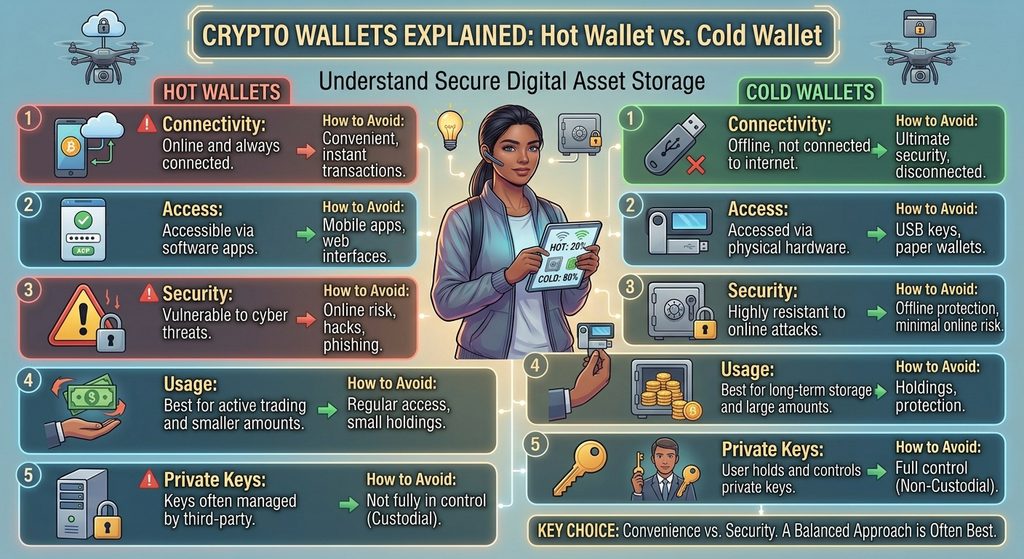
A hot wallet is connected to the internet, making it convenient for frequent transactions. A cold wallet keeps the relevant keys offline, which can reduce exposure to certain online attacks.
Neither option is automatically perfect for every situation. The right choice depends on how you use cryptocurrency, how much you hold, and how comfortable you are managing security yourself.
What Is a Crypto Wallet?
A crypto wallet is software, hardware, or another mechanism used to manage the credentials associated with your cryptocurrency.
Your crypto itself generally remains recorded on a blockchain.
Think of it this way:
Blockchain = the public record
Private key = the secret credential that helps control your assets
Wallet = the tool used to manage those credentials
Your wallet may also provide an address that other people can use to send cryptocurrency to you.
The most important thing to understand is that protecting your private keys is critical. Someone who obtains the credentials controlling your crypto may be able to transfer the assets.
What Is a Hot Wallet?
A hot wallet is a cryptocurrency wallet that is connected to the internet.
Hot wallets are commonly available as:
- Mobile apps
- Desktop applications
- Browser extensions
- Web wallets
Because they’re connected to the internet, hot wallets are generally convenient for buying, selling, swapping, and transferring cryptocurrency.
Example
Suppose you regularly use cryptocurrency for transactions.
You might keep a relatively small amount in a hot wallet so that you can quickly access it when needed.
Advantages of Hot Wallets
Easy access:
You can usually access your assets quickly from your phone or computer.
Convenient transactions:
Hot wallets are useful when you frequently send or receive cryptocurrency.
Easy to use:
Many modern wallets are designed for beginners.
Useful for decentralized applications:
Some hot wallets can connect directly to blockchain-based applications and services.
Disadvantages of Hot Wallets
The major disadvantage is that an internet-connected wallet can be exposed to online threats.
Potential risks include:
- Phishing
- Malware
- Fake wallet applications
- Compromised devices
- Malicious websites
- Theft of passwords or wallet credentials
The SEC warns that digital assets held through wallets and custodial services can face risks including hacking, theft, loss of credentials, and other security problems.
What Is a Cold Wallet?
A cold wallet generally refers to a method of keeping cryptocurrency wallet credentials offline.
Hardware wallets are a common example.
A hardware wallet is a physical device designed to keep private keys isolated from an internet-connected computer or phone.
The basic idea is simple:
Hot wallet → connected to the internet
Cold wallet → credentials kept offline
Because the private keys aren’t continuously exposed to an internet-connected environment, cold storage can reduce certain types of online attack risks.
However, cold storage isn’t completely risk-free.
You still need to protect the device, PINs, recovery information, and transaction process.
Hot Wallet vs Cold Wallet: Key Differences
| Feature | Hot Wallet | Cold Wallet |
|---|---|---|
| Internet connection | Usually connected | Generally offline |
| Convenience | Very high | Moderate |
| Transaction speed | Usually fast | Can require additional steps |
| Security against online attacks | More exposure | Generally less online exposure |
| Best suited for | Frequent transactions | Longer-term storage |
| Physical device required | Not necessarily | Often, but not always |
| Beginner-friendly | Usually | Requires more security awareness |
| Main risk | Online attacks and phishing | Loss, theft, or mishandling of credentials/device |
The distinction isn’t simply “hot equals unsafe” and “cold equals safe.”
Both require good security practices.
How Hot Wallets Work
Imagine you download a cryptocurrency wallet application on your smartphone.
You create a wallet and receive a recovery phrase.
The wallet generates the cryptographic credentials needed to control your cryptocurrency.
When you want to send cryptocurrency, the wallet uses the relevant private key to authorize the transaction.
The transaction is then broadcast to the blockchain network.
The wallet doesn’t physically move coins from one digital location to another. Instead, the blockchain records the transfer of control.
How Cold Wallets Work
With a hardware wallet, the private key is designed to remain protected within the device.
When you want to make a transaction, the transaction can be prepared using an internet-connected computer or phone.
The hardware wallet can then authorize the transaction without exposing the private key itself to the connected device.
This architecture can reduce the risk associated with keeping private keys directly on an internet-connected computer.
However, users still need to verify transaction details carefully.
A malicious website or compromised computer could potentially attempt to trick you into approving a transaction you didn’t intend to make.
What Is a Private Key?
A private key is a cryptographic credential associated with control of cryptocurrency.
It should be treated like extremely sensitive information.
If someone obtains the private key controlling your assets, they may be able to transfer those assets.
That’s why you should never casually share private keys.
A legitimate company or support representative should not ask you to provide your private key simply to “verify” your wallet.
What Is a Seed Phrase?
A seed phrase, sometimes called a recovery phrase or secret recovery phrase, is a sequence of words used by many self-custody wallets to recover access to a wallet.
For example, a wallet might generate a sequence of words that you are instructed to write down and protect.
The exact words should never be shared with anyone.
If another person obtains your recovery phrase, they may be able to restore the wallet and control the cryptocurrency associated with it.
The SEC specifically warns investors to protect private keys and seed phrases because losing or compromising them can result in permanent loss of access to crypto assets.
Where Should You Keep Your Seed Phrase?
If you’re using a self-custody wallet, protecting your recovery phrase is one of the most important things you can do.
Avoid storing it where someone else could easily access it.
Don’t:
- Post it online
- Send it through social media
- Email it to yourself unnecessarily
- Give it to a stranger
- Enter it into an unknown website
- Share it with supposed “customer support”
- Store it in a public document
Be particularly careful with screenshots and cloud storage because compromising the associated account could expose sensitive information.
For significant holdings, some users consider offline physical backups and additional security arrangements.
Is a Hot Wallet Safe?
A hot wallet can be reasonably secure when used carefully, but being connected to the internet introduces additional attack surfaces.
Security depends on factors such as:
- The wallet software
- Your device security
- Password strength
- Multifactor authentication where available
- Your browsing habits
- Phishing awareness
- How carefully you approve transactions
A hot wallet should not automatically be considered unsafe.
For example, someone who makes frequent small transactions may value convenience and accessibility.
The important question is whether the security setup is appropriate for the amount and purpose of the funds.
Is a Cold Wallet Completely Safe?
No.
Cold storage can reduce exposure to some online threats, but it doesn’t eliminate all risks.
You could still:
- Lose the hardware device
- Lose your recovery phrase
- Forget a PIN
- Purchase a fraudulent device
- Approve a malicious transaction
- Damage the device
- Fall victim to phishing
- Reveal your recovery information
The SEC notes that self-custody comes with significant responsibility because losing or compromising private keys can permanently prevent access to crypto assets.
Cold storage is therefore better understood as a security approach, not a guarantee against loss.
What Is a Custodial Wallet?
There’s another important distinction beginners should understand: custodial vs. self-custody.
With a custodial arrangement, a third party—such as a cryptocurrency platform—holds the relevant private keys on your behalf.
You typically access your account using a username, password, and other security controls.
With self-custody, you control the private keys yourself.
Custodial
You: manage account access
Company: controls the private keys
Self-custody
You: control the private keys
You: responsible for securing them
The SEC notes that both third-party custody and self-custody involve different risks. A custodian can be hacked or become insolvent, while self-custody can result in permanent loss if the owner loses the necessary credentials.
Hot Wallet vs Cold Wallet: Which One Should Beginners Use?
There isn’t one universal answer.
Consider your intended use.
If you make frequent transactions
A hot wallet may be more convenient because you can quickly access your cryptocurrency.
If you’re storing cryptocurrency for a longer period
Cold storage may be worth considering because keeping the relevant credentials offline can reduce certain online risks.
If you’re holding a significant amount
Security becomes particularly important. Some users choose to keep only a limited amount readily accessible while storing longer-term holdings using stronger offline security arrangements.
The key principle is:
Don’t keep more online than you’re comfortable exposing to online risks.
A Simple Strategy for Beginners
A beginner could think about crypto storage in three categories:
Everyday spending
Keep only the amount needed for regular transactions in a convenient wallet.
Active trading
Use the wallet or exchange necessary for your trading activity while maintaining strong account security.
Long-term holdings
Consider an appropriate cold-storage or self-custody solution if you understand how to securely manage private keys and recovery information.
This approach separates convenience from long-term storage.
8 Common Crypto Wallet Security Mistakes
1. Sharing Your Seed Phrase
Never share it.
2. Downloading Fake Wallet Apps
Only obtain wallet software from legitimate sources and verify the publisher carefully.
3. Clicking Suspicious Links
A phishing website can look almost identical to a legitimate wallet or exchange.
4. Using Weak Passwords
Use strong, unique credentials wherever passwords are involved.
5. Keeping Everything Online
Convenience is useful, but large long-term holdings may deserve stronger security arrangements.
6. Ignoring Transaction Details
Always verify the destination address, network, and transaction amount before approving a transfer.
7. Trusting Fake Support Agents
Scammers frequently impersonate cryptocurrency customer-support representatives.
8. Losing Your Recovery Backup
Self-custody means you are responsible for maintaining access to your wallet.
What Happens If You Lose Your Wallet?
This depends on the type of wallet.
If you’re using a custodial service, you may be able to recover access through the company’s account-recovery process.
With self-custody, the situation is different.
If you lose your device but still have your recovery phrase, you may be able to restore your wallet using compatible wallet software.
But if you lose both your wallet credentials and the recovery information needed to restore them, you may permanently lose access to your cryptocurrency.
That’s why self-custody requires careful planning.
Hot Wallet vs Cold Wallet: Quick Summary
| Question | Hot Wallet | Cold Wallet |
|---|---|---|
| Connected to the internet? | Usually | Generally no |
| Convenient for daily use? | Yes | Less convenient |
| Suitable for frequent transactions? | Yes | Not usually the primary advantage |
| Reduced online exposure? | No | Yes |
| Requires more physical security? | Usually less | Yes |
| Recovery phrase important? | Often | Yes |
| Completely risk-free? | No | No |
Final Thoughts
The difference between hot and cold wallets comes down primarily to connectivity, convenience, and security trade-offs.
A hot wallet provides easy access and is useful for frequent transactions, but its internet connection creates additional exposure to online threats.
A cold wallet keeps wallet credentials offline and can reduce certain online risks, making it a commonly considered option for longer-term storage. However, it requires greater personal responsibility.
The most important lesson for any crypto user is simple:
Your cryptocurrency security is only as strong as the way you protect the credentials that control it.
Whether you use a hot wallet, cold wallet, custodial service, or self-custody solution, never share your private keys or recovery phrase, verify transactions carefully, and remain alert to phishing and impersonation scams.
This article is for educational purposes only and is not financial or investment advice.