10 Common Crypto Scams and How to Avoid Them
 admin
11 min read
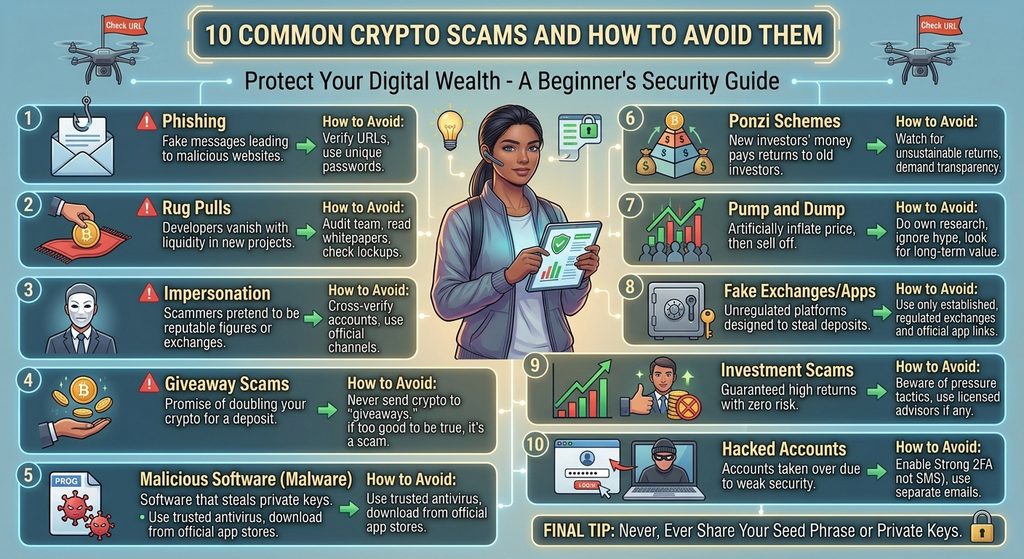
Cryptocurrency has created new opportunities for investing, payments, and financial technology. Unfortunately, it has also created new opportunities for scammers.
Crypto transactions can be difficult or impossible to reverse once completed, making cryptocurrency an attractive payment method for criminals. Government agencies including the Federal Trade Commission (FTC), Commodity Futures Trading Commission (CFTC), and Securities and Exchange Commission (SEC) regularly warn consumers about cryptocurrency-related fraud.
In 2025, U.S. consumers reported more than $7.9 billion in losses to investment scams, according to FTC data. Scammers increasingly use social media, messaging apps, fake investment platforms, and impersonation tactics to gain victims’ trust.
If you’re interested in cryptocurrency, knowing how common scams work can help you recognize warning signs before sending your money.
Here are 10 common crypto scams and practical ways to avoid them.
1. Fake Crypto Investment Platforms
One of the most common crypto scams involves fake investment websites or apps.
A scammer may contact you through social media, WhatsApp, Telegram, email, or another platform and claim to have a highly profitable cryptocurrency investment opportunity.
The website may look professional. It may even display a dashboard showing that your investment is increasing.
The problem is that the investment isn’t real.
When you try to withdraw your money, the platform may demand additional taxes, processing fees, verification payments, or other charges. After receiving more money, the scammers may disappear.
The FTC warns that fake investment websites can display fabricated profits while preventing victims from withdrawing their money.
How to avoid it
Before sending money:
- Research the company independently.
- Search its name along with words such as “scam,” “review,” and “complaint.”
- Don’t trust screenshots showing supposed profits.
- Don’t send additional money simply because a website says you must pay a fee to withdraw.
- Verify that you’re dealing with a legitimate, properly established business.
2. Romance Crypto Scams
Romance scams combine emotional manipulation with fake investment opportunities.
A scammer may meet someone through a dating app or social media and gradually build a relationship. After gaining the victim’s trust, they introduce cryptocurrency investing.
They may claim to be highly successful at crypto trading and offer to teach their new partner how to invest.
Eventually, they ask the victim to send cryptocurrency or transfer money to an investment platform they control.
The FTC specifically warns consumers never to combine online dating with investment advice from someone they haven’t met in person.
How to avoid it
Be extremely cautious if an online romantic interest:
- Offers to manage your crypto investments.
- Promises guaranteed profits.
- Tells you to transfer crypto to their wallet.
- Introduces you to a particular investment website.
- Avoids meeting in person while repeatedly requesting money.
Never send cryptocurrency to an online romantic interest simply because you’ve developed trust or feelings for them.
3. Celebrity Giveaway Scams
Celebrity impersonation is another common cryptocurrency scam.
A scammer may create a fake social-media account pretending to be a famous person, entrepreneur, influencer, or cryptocurrency expert.
They might claim:
“Send cryptocurrency to this address and we’ll send back twice as much.”
The promise of free cryptocurrency can be extremely tempting, but legitimate celebrities don’t need strangers to send them cryptocurrency in order to receive a larger amount back.
The FTC specifically warns about scammers impersonating celebrities and promising to multiply cryptocurrency sent to them.
How to avoid it
- Don’t trust cryptocurrency giveaways promising guaranteed returns.
- Verify celebrity accounts through their official channels.
- Don’t send crypto to an address promoted through an unexpected social-media message.
- Be suspicious of urgency and limited-time giveaway claims.
- Remember that blockchain transactions generally cannot simply be reversed after confirmation.
4. Phishing Scams
Phishing scams attempt to steal your login information, private information, or wallet credentials.
You might receive an email or message claiming:
- Your crypto account has been suspended.
- Your wallet requires verification.
- There has been suspicious activity.
- You need to update your account.
- You must connect your wallet to receive a payment.
The message may contain a link leading to a fake website that looks almost identical to the legitimate service.
CFTC guidance warns consumers not to click unexpected links or QR codes because they can lead to spoofed websites designed to steal information or money.
How to avoid it
Instead of clicking the link:
- Open your browser yourself.
- Enter the official website address manually or use a trusted bookmark.
- Log in normally.
- Check whether there is actually an account problem.
- Contact official customer support if necessary.
Never enter your wallet’s recovery phrase into a website simply because an unexpected message tells you to.
5. Fake Customer Support Scams
Imagine you have a problem withdrawing cryptocurrency.
You search online for help and find someone claiming to be customer support.
They ask for your:
- Password
- Authentication code
- Private key
- Recovery phrase
- Wallet access
- Remote computer access
This can be a scam.
Fraudsters may impersonate cryptocurrency exchanges, wallet providers, or other companies to convince victims to reveal information or transfer assets.
How to avoid it
Only contact customer support through the official company’s website or application.
Never give customer support representatives:
- Your password
- Your 2FA code
- Your private key
- Your seed phrase
A legitimate support representative should not need your wallet’s recovery phrase to “unlock” your cryptocurrency.
6. Pump-and-Dump Crypto Scams
Pump-and-dump schemes typically involve a relatively unknown cryptocurrency or token.
Scammers aggressively promote the token on social media, messaging groups, or online communities.
They create excitement by claiming that the cryptocurrency is about to “explode.”
As more people buy, the price may rise.
The people behind the scheme then sell their holdings at the inflated price.
After they sell, the price can collapse, leaving later buyers with significant losses.
The CFTC identifies pump-and-dump schemes as a common form of digital-asset fraud, particularly involving heavily promoted lesser-known tokens or projects.
How to avoid it
Be careful when you see:
- “Buy before it’s too late!”
- “Guaranteed 100x!”
- Anonymous groups promising secret crypto picks.
- Sudden hype around an unknown token.
- Influencers encouraging followers to buy without explaining the project’s fundamentals.
Don’t purchase an asset simply because its price is rising rapidly.
7. Fake Crypto Jobs
Some scammers advertise fake jobs related to cryptocurrency.
The position may sound legitimate and could involve:
- Crypto trading
- Mining
- Marketing
- Recruiting investors
- Customer service
- Account management
After communicating with you, the scammer may say you need to pay a registration fee, purchase cryptocurrency, deposit money, or send crypto to a supposed client.
The FTC warns that legitimate employers don’t require applicants to pay cryptocurrency to obtain a job.
How to avoid it
Never:
- Pay cryptocurrency to get a job.
- Deposit a check and send part of the money back in crypto.
- Purchase crypto for a supposed employer or client without independently verifying the arrangement.
- Give strangers access to your cryptocurrency wallet.
Research the company independently and verify the job through its official website.
8. Government or Business Impersonation Scams
A scammer may pretend to be from:
- A government agency
- A bank
- A cryptocurrency exchange
- A technology company
- A utility company
- Law enforcement
- Another trusted organization
They may claim your account has been compromised or that you owe money.
Then they tell you to purchase cryptocurrency and send it to a particular wallet to “protect” your money.
That’s a major warning sign.
The FTC says legitimate businesses and government agencies will not unexpectedly demand that consumers purchase cryptocurrency and send it to them.
How to avoid it
If someone contacts you unexpectedly and demands crypto:
Stop. Don’t send anything.
Find the organization’s official contact information independently and contact it directly.
Don’t use the phone number, link, or QR code supplied by the suspicious message.
9. Blackmail and Extortion Scams
Some scammers threaten to release embarrassing or personal information unless you pay them cryptocurrency.
They may claim they have:
- Private photographs
- Videos
- Personal information
- Browsing history
- Other compromising material
The scammer then demands cryptocurrency to keep the information private.
The FTC identifies cryptocurrency as one payment method used in blackmail scams.
How to avoid it
Don’t automatically assume that paying will solve the problem.
Instead:
- Don’t send cryptocurrency.
- Preserve evidence of the threats.
- Don’t provide additional personal information.
- Report the incident to the relevant platform and appropriate law-enforcement authorities.
If you believe your account has been compromised, change your passwords and enable multifactor authentication.
10. Fake Crypto Recovery Services
This scam often targets people who have already lost money to a cryptocurrency scam.
Someone contacts the victim claiming they can recover the stolen cryptocurrency.
They may claim to be:
- Blockchain investigators
- Cryptocurrency recovery experts
- Lawyers
- Cybersecurity specialists
- Government-connected investigators
They then demand an upfront payment or cryptocurrency fee.
After receiving the money, they may disappear or demand even more.
CFTC guidance specifically warns people not to pay additional money out of pocket simply to recover supposed profits or principal from a fraudulent investment.
How to avoid it
Be suspicious of anyone who:
- Guarantees recovery of stolen crypto.
- Contacts you unexpectedly after you’ve been scammed.
- Demands cryptocurrency upfront.
- Claims they have already recovered your funds.
- Asks for your private keys or wallet recovery phrase.
There is no magic process that guarantees cryptocurrency recovery.
7 Red Flags That a Crypto Offer May Be a Scam
Regardless of the specific scam, certain warning signs appear repeatedly.
1. Guaranteed profits
There is no legitimate investment that can guarantee cryptocurrency profits.
The CFTC specifically warns that guaranteed or risk-free crypto returns are a major red flag.
2. Extreme urgency
Scammers don’t want you to have time to research their claims.
Watch out for:
- “Buy today!”
- “Last opportunity!”
- “You have 10 minutes!”
- “Don’t tell anyone.”
- “Send the payment immediately.”
3. Unsolicited investment advice
Be cautious when a stranger contacts you through social media and suddenly offers cryptocurrency investment advice.
4. Requests for cryptocurrency payments
Cryptocurrency can be difficult to reverse once sent, making it attractive to scammers.
5. Requests for private information
Never give strangers your:
- Seed phrase
- Private key
- Password
- Authentication codes
6. Fake proof of profits
Screenshots, trading dashboards, testimonials, and account balances can be fabricated.
7. Pressure to deposit more money
If someone tells you that you must pay another fee before withdrawing your supposed profits, stop and investigate.
How to Check a Crypto Investment Before Sending Money
Before sending cryptocurrency, take a few minutes to investigate.
Step 1: Research the company
Search for the company’s name together with terms such as:
“scam” + “complaint” + “review”
The FTC recommends this type of research before investing.
Step 2: Investigate the people behind it
Look for verifiable information about the founders, company, and business operations.
Don’t rely exclusively on testimonials posted on the investment website.
Step 3: Check regulatory information where relevant
Depending on the type of investment and jurisdiction, check whether the company or professional is properly registered or licensed.
Step 4: Don’t trust social-media hype
A large following doesn’t prove that an investment opportunity is legitimate.
The CFTC notes that many digital-asset scams originate on social media and messaging platforms.
Step 5: Never rush
If someone won’t allow you enough time to research an investment, that’s itself a warning sign.
What Should You Do If You Sent Crypto to a Scammer?
Act quickly.
1. Stop sending money
Don’t send additional funds even if the scammer promises that another payment will unlock your money.
2. Contact the company you used to send the crypto
If you purchased cryptocurrency through an exchange or payment service, contact its official support channel immediately and explain that you were scammed.
The FTC recommends contacting the company or service used to send the payment as soon as possible.
3. Secure your accounts
Change compromised passwords and enable multifactor authentication.
4. Preserve evidence
Save:
- Wallet addresses
- Transaction IDs
- Screenshots
- Emails
- Phone numbers
- Social-media profiles
- Website addresses
- Messages
5. Report the scam
In the United States, consumers can report fraud to the FTC through ReportFraud.ftc.gov. Other countries have their own consumer-protection and law-enforcement reporting systems.
Final Thoughts
Cryptocurrency scams often rely on the same basic psychological tactics: trust, urgency, greed, fear, and promises of easy money.
A professional-looking website doesn’t guarantee that an investment is legitimate. A large social-media following doesn’t prove that someone is trustworthy. And a screenshot showing huge profits doesn’t mean those profits actually exist.
The safest approach is to slow down and investigate before sending cryptocurrency.
Remember these basic rules:
No guaranteed profits.
No rushed decisions.
No unknown investment platforms.
No payments to strangers.
No sharing private keys or seed phrases.
No trusting unsolicited crypto advice.
If an opportunity sounds too good to be true, take time to verify it before putting your money at risk.
This article is for educational purposes only and is not financial or investment advice.