How to Buy Cryptocurrency Safely: A Step-by-Step Guide for Beginners
 admin
10 min read
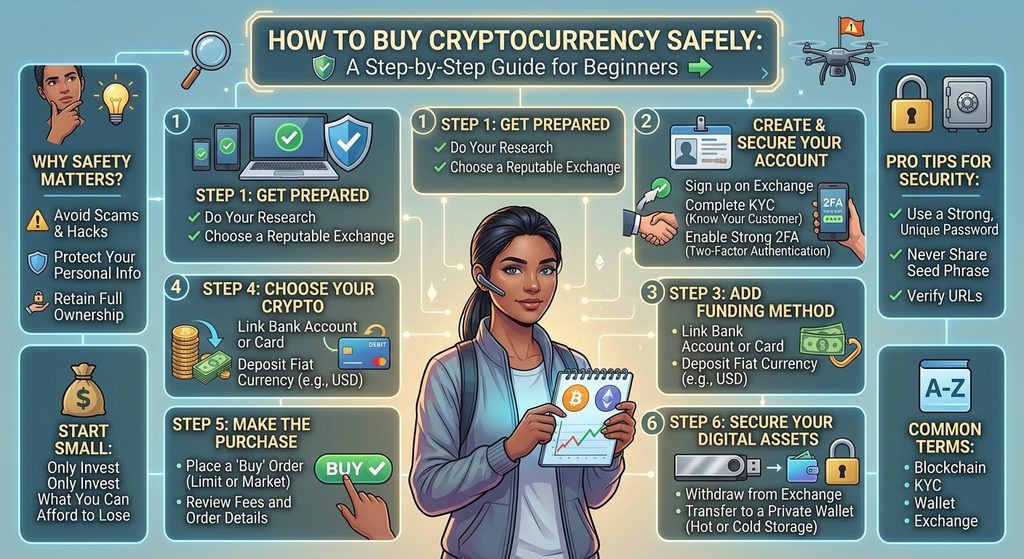
Buying cryptocurrency for the first time can seem complicated, especially with thousands of coins, different exchanges, wallets, fees, and security risks. The good news is that the basic process is straightforward once you understand the important steps.
However, cryptocurrency is a high-risk and highly volatile asset class. Regulators including the CFTC and FCA warn that investors can lose some or all of their money, and scams are common.
This beginner-friendly guide explains how to buy cryptocurrency safely, from choosing an exchange to protecting your crypto after your purchase.
1. Understand What Cryptocurrency Is Before Buying
Cryptocurrency is a digital asset that typically operates using blockchain or distributed-ledger technology. Unlike traditional bank deposits, crypto transactions generally operate through blockchain networks rather than a conventional bank account.
Popular cryptocurrencies include Bitcoin, Ethereum and thousands of other digital assets. But they are not all equally established or liquid, and smaller tokens can carry substantially greater risks.
Before buying anything, understand:
- What the cryptocurrency actually does
- Which blockchain it uses
- Why the token has value
- How many tokens exist
- What fees are involved
- How you can buy and sell it
- Where you will store it
The CFTC recommends conducting extensive research and avoiding products or strategies you don’t understand.
2. Decide How Much You Can Afford to Lose
One of the biggest beginner mistakes is treating cryptocurrency like a guaranteed investment.
It isn’t.
Crypto prices can move sharply in either direction. The FCA specifically warns that people considering crypto should be prepared to lose all the money they invest.
Before making a purchase, establish a maximum amount you are comfortable risking.
For example, instead of putting your emergency savings into cryptocurrency, you might decide to start with a small amount while learning how the market and wallets work.
Never borrow money simply to buy cryptocurrency.
3. Choose a Reputable Cryptocurrency Exchange
Most beginners purchase cryptocurrency through a centralized crypto exchange.
An exchange allows you to:
- Create an account
- Verify your identity
- Deposit money
- Select a cryptocurrency
- Place an order
- Hold or withdraw your crypto
Before depositing money, research the exchange carefully. The CFTC advises investors to investigate the legitimacy of trading platforms and digital wallets before providing money or sensitive information.
Look at:
- Regulatory status in your jurisdiction
- Security history
- Available cryptocurrencies
- Deposit and withdrawal methods
- Trading fees
- Withdrawal fees
- Customer support
- Withdrawal restrictions
- Two-factor authentication
- Reputation and transparency
Don’t choose an exchange simply because someone on TikTok, YouTube, Telegram, Reddit or another social platform recommended it.
4. Make Sure You’re Using the Official Website or App
Phishing is one of the easiest ways for criminals to steal cryptocurrency.
A scammer may create a website that looks almost identical to a legitimate exchange. You enter your email, password or verification code, and the attacker obtains your information.
Before logging in:
- Type the exchange’s address yourself or use a trusted bookmark.
- Check the domain carefully.
- Avoid links sent through unsolicited messages.
- Download mobile apps from legitimate app stores.
- Never provide your password or authentication code to another person.
The SEC specifically recommends watching for crypto phishing scams and using strong passwords and multifactor authentication.
5. Create Your Account and Complete Verification
After selecting an exchange, create your account using an email address and a strong, unique password.
Many legitimate exchanges require Know Your Customer (KYC) verification before allowing users to purchase or withdraw cryptocurrency.
Depending on the platform and jurisdiction, verification may require information such as:
- Full name
- Date of birth
- Address
- Government-issued identification
- Additional verification information
Only provide sensitive information through the exchange’s official website or application.
6. Turn On Two-Factor Authentication
Don’t wait until after you’ve bought crypto to secure your account.
Enable two-factor authentication (2FA) immediately.
2FA adds another security layer beyond your password. Depending on the platform, you may be able to use an authenticator application or another supported authentication method.
Also:
- Use a unique password.
- Don’t reuse your exchange password elsewhere.
- Secure your email account with 2FA.
- Never share authentication codes.
- Don’t save sensitive recovery information in easily accessible locations.
The SEC lists strong passwords and multifactor authentication among its general crypto-security recommendations.
7. Deposit Money Into Your Account
Once your account is secured and verified, use one of the payment methods supported by your exchange.
Depending on your location, these might include:
- Bank transfer
- Debit card
- Credit card
- Other supported payment services
- Peer-to-peer transactions
Always check the total cost before confirming the deposit.
A payment method can have a different fee or processing time from another method.
8. Choose the Cryptocurrency You Want to Buy
Now comes the important part: deciding what you actually want to purchase.
Don’t select a cryptocurrency simply because its price has recently increased.
Research:
Market capitalization
Market capitalization gives you an idea of the cryptocurrency’s overall market value.
Liquidity
Higher liquidity generally makes it easier to buy or sell an asset without significantly affecting its market price.
Token supply
Look at the circulating supply and maximum or potential future supply.
Technology
Understand what blockchain or application the cryptocurrency is designed to support.
Development
Research the project, developers, documentation and ongoing development.
Risks
Look for potential vulnerabilities, regulatory issues, concentration of ownership and other risks.
The CFTC recommends examining factors such as liquidity, technology, adoption, competition and the risks of hacking before purchasing digital coins or tokens.
9. Start With a Small Purchase
Your first transaction doesn’t need to be large.
A small purchase allows you to learn:
- How the exchange works
- How orders are executed
- What fees you pay
- How deposits work
- How withdrawals work
- How crypto addresses work
It also gives you an opportunity to learn the process without immediately exposing a large amount of money.
10. Place Your First Buy Order
Once you’ve selected your cryptocurrency, you’ll normally see an option such as Buy.
You may encounter different order types.
Market order
A market order attempts to execute your purchase at the currently available market price.
Limit order
A limit order allows you to specify the maximum price you’re willing to pay for the asset.
For a beginner, understanding the difference between these order types is important before placing a transaction.
Before confirming your purchase, check:
- Cryptocurrency amount
- Price
- Trading fee
- Total cost
- Order type
Then confirm the transaction.
11. Understand Where Your Cryptocurrency Is Stored
After purchasing crypto, you need to understand custody.
There are two broad approaches:
Exchange custody
The exchange controls the private keys associated with your crypto.
This is convenient because you can access your assets through your exchange account, but it means you depend on the exchange for access and security.
Self-custody
You control your own private keys through a crypto wallet.
This gives you greater direct control, but it also gives you greater responsibility.
The SEC explains that if you use self-custody, losing or compromising your private keys or seed phrase can result in permanent loss of access. Third-party custody also carries risks if the custodian is hacked, shuts down or becomes insolvent.
12. Learn the Difference Between Hot and Cold Wallets
A hot wallet is connected to the internet and is generally convenient for regular transactions.
A cold wallet keeps the relevant private keys offline and is commonly used for longer-term storage.
For beginners, the important concept isn’t simply choosing one immediately. First understand what you’re responsible for.
Your wallet doesn’t literally contain the cryptocurrency. Wallets generally store the private keys or credentials used to access crypto assets on the blockchain.
13. Protect Your Seed Phrase
If you create a self-custody wallet, you may receive a seed phrase, also called a recovery phrase.
This can be extremely important because it may allow someone to restore your wallet.
Never:
- Send your seed phrase to someone
- Enter it into a website because someone instructed you to
- Give it to “customer support”
- Post it online
- Store it in a public document
- Take unnecessary screenshots of it
The SEC explicitly advises investors never to share private keys or seed phrases.
If someone asks for your seed phrase, treat that as a major warning sign.
14. Double-Check Crypto Addresses
Crypto transfers are different from many traditional payment methods.
If you send cryptocurrency to the wrong address or wrong network, recovering the funds may be extremely difficult or impossible.
Before making a withdrawal:
- Copy the destination address.
- Verify the first characters.
- Verify the last characters.
- Confirm the correct blockchain/network.
- Check whether a memo or tag is required.
- Send a small test transaction when appropriate.
- Confirm that the recipient received it before sending a larger amount.
The CFTC notes that many digital-asset transactions are effectively irreversible, making careful verification especially important.
15. Watch Out for Common Crypto Scams
Crypto scams can take many forms.
Guaranteed profits
Anyone promising guaranteed cryptocurrency returns should immediately raise suspicion.
The CFTC states that there is no guaranteed or risk-free crypto investment or trading strategy.
Fake investment platforms
A website may show you imaginary profits while preventing withdrawals unless you pay additional fees.
Romance scams
Someone you meet online may eventually ask you to send cryptocurrency or invest through their “special” platform.
Fake customer support
A scammer may impersonate an exchange employee and request your password, authentication code or seed phrase.
Fake giveaways
You may see claims such as:
“Send 1 ETH and receive 2 ETH back.”
Treat these as scams.
Social-media investment groups
Be particularly careful with unsolicited investment recommendations through Telegram, WhatsApp, Instagram, X, Facebook or other platforms.
The CFTC specifically warns about people being invited to invest through online contacts and social media.
16. Keep Records of Your Transactions
Save records of your cryptocurrency activity.
Depending on your country, you may need transaction information for tax reporting.
Keep records such as:
- Purchase date
- Cryptocurrency purchased
- Amount
- Purchase price
- Transaction fees
- Withdrawal information
- Sale information
- Transaction IDs
Tax rules differ significantly between countries, so check the rules that apply to your jurisdiction.
17. Don’t Let FOMO Control Your Decisions
One of the biggest psychological risks in crypto is FOMO — fear of missing out.
You may see posts claiming:
“This coin is about to explode!”
or
“Buy now before it’s too late!”
Don’t make financial decisions based solely on hype.
Instead, ask:
- What am I buying?
- Why am I buying it?
- What could cause its value to fall?
- How much could I afford to lose?
- Can I explain the investment without relying on social-media hype?
The FCA recommends looking beyond hype and taking time to understand the risks before investing.
Beginner Cryptocurrency Safety Checklist
Before buying your first cryptocurrency, make sure you can answer yes to these questions:
| Safety Check | Done? |
|---|---|
| I understand what cryptocurrency I’m buying | ☐ |
| I researched the exchange | ☐ |
| I’m using the official exchange website/app | ☐ |
| I created a unique password | ☐ |
| I enabled 2FA | ☐ |
| I understand the fees | ☐ |
| I’m only investing money I can afford to lose | ☐ |
| I understand where my crypto will be stored | ☐ |
| I understand private keys and seed phrases | ☐ |
| I know never to share my seed phrase | ☐ |
| I understand how crypto addresses and networks work | ☐ |
| I know crypto transactions may be irreversible | ☐ |
| I can recognize common scams | ☐ |
Final Thoughts
Buying cryptocurrency safely isn’t just about finding a button that says Buy. The most important part is understanding the entire process: research the asset, choose the platform carefully, secure your account, start small, understand custody, protect your private keys and avoid unrealistic promises.
Cryptocurrency can offer opportunities, but it also carries substantial risks. Official investor guidance emphasizes research, security, caution around scams and investing only what you can afford to lose.
For a beginner, the goal shouldn’t be to rush into the market. Learn first, secure everything, and then make an informed decision.
This article is for educational purposes and is not personalized financial or investment advice.